Why Scan-Ready Garment Barcodes Matter
For apparel manufacturers, buying houses and garment exporters, a barcode or QR code connects a physical item to information in a stock, order or traceability system. A code that looks acceptable to the eye can still fail a scanner if fine bars merge, contrast is weak, or the code is printed too small for the intended reader.
Planning the label around the buyer's actual data format, scanning equipment and garment application helps reduce avoidable relabelling and packing-line delays. The same checks matter to factories in Tirupur, Bangalore and other Indian textile export hubs producing for multiple retail partners.
Choose the Right Barcode or QR Code Format
Start with the specification supplied by your buyer or inventory system. A linear barcode may suit a product identifier or retail point-of-sale workflow; a 2D QR code can hold or link to more information, depending on the system. GS1 formats, including GS1 Digital Link QR codes, should be used only when the customer or supply-chain program calls for them.
Do not convert or redraw approved artwork casually. Ask the buyer for the exact symbol type, encoded data, human-readable text, target dimensions and any required verification grade. A standards-compliant format is not, by itself, a guarantee that the printed symbol will scan reliably.
How to Improve Barcode and QR Code Print Clarity
- Protect contrast: Dark bars or modules on a light, even background are generally easier for scanners to read. Avoid placing codes over patterns, photos or colored artwork.
- Keep the quiet zone clear: Preserve the unprinted margin around the symbol specified for its symbology. Text, borders, folds and adjacent graphics should not intrude into that area.
- Use adequate size and resolution: Fine features can close up during printing or become unreadable when reduced. Follow the customer's dimensions and test at the final production size.
- Check print consistency: Smudges, gaps, broken bars, ribbon or ink variation, and uneven pressure can affect scans across a batch.
- Position for real use: Keep the code flat, visible and away from seams, folds and curved or heavily textured areas where possible.
For compact care information, printed taffeta labels offer a crisp surface often selected for bulk garment production. A satin printed label may suit a softer hand-feel or a premium presentation. The substrate, print process and code size should be evaluated together rather than selected independently.
Select a Garment Label Material for the Use Case
Consider where the code will be placed and what it must withstand. A sewn-in care label has different handling and laundering exposure from a hangtag or a temporary packaging label. Check the fabric, fold, intended location, print technology and expected wear with your label supplier; then confirm the final sample against the buyer's scanning conditions.
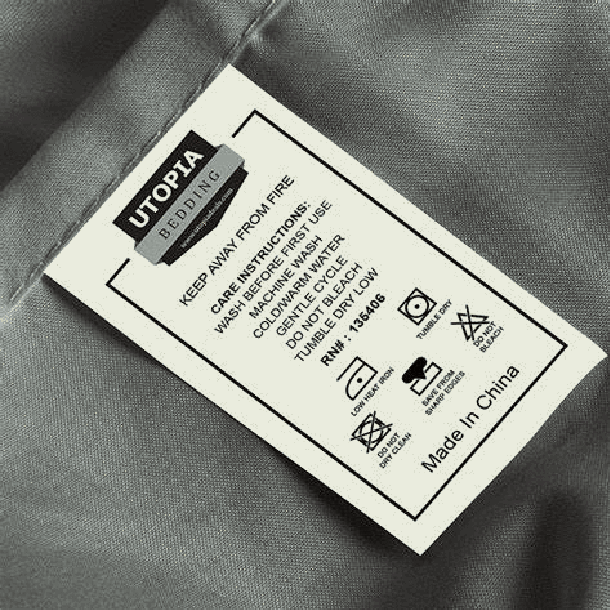
If the barcode shares space with care instructions, ensure the code and required text remain distinct and legible. Our wash care label guide covers the information commonly planned for export garment labels.
Verify the Printed Code Before Bulk Production
A phone camera can provide a quick preliminary check, but it is not a substitute for verification against the applicable specification. For formal print-quality grading, linear barcodes and 2D symbols have separate test methods, such as ISO/IEC 15416 and ISO/IEC 15415 respectively. Confirm the required method and acceptance grade with the buyer or program owner before production.
- Approve the source data and encoded value with the customer.
- Review a production-size artwork proof, including the quiet zone and placement.
- Print a representative sample using the intended material and process.
- Scan or verify samples with equipment appropriate to the buyer's workflow.
- Retain the approved reference and check samples from the production batch.
Testing only a screen preview or a single ideal sample can miss variation that appears during a long run. If the buyer provides a verification procedure, use it as the acceptance reference.
Request Barcode-Ready Garment Label Samples
When requesting a quote from a garment label manufacturer in India, share the code artwork or data, required symbology, finished size, label material, garment position, order quantity and buyer's verification criteria. If the code is dynamic or unique per garment, clarify the variable-data workflow and provide representative test values before approving production.
SR Labels supplies custom printed labels for manufacturers, fashion brands and exporters. Contact our team to discuss a suitable label material and request a sample for your production requirements.
Need Clear, Scan-Ready Garment Labels?
Send your label specification and sample requirements to SR Labels for a product discussion and quote.